- What is the ‘Central Dogma’? (n.d.). @Yourgenome · Science Website. https://www.yourgenome.org/facts/what-is-the-central-dogma/
Wednesday, 14 December 2022
Central Dogma
Sunday, 27 March 2022
Polymerase Chain Reaction - Glossary
- Amplification- Increase in the number of copies of the desired DNA fragment.
- Annealing- Attachment of an oligonucleotide primer to the DNA or RNA template.
- Chromosome- Structures found in nucleus which carry the DNA molecule and the DNA holds gene.
- Ct (cycle threshold)- The number of cycles required for the fluorescent signal to exceed levels.
- Denaturation- The process of breaking of hydrogen bonds between the DNA bases in the DNA and converting DNA from double stranded to single stranded.
- deoxynucleotide triphosphates (dNTPs) - Building blocks of DNA synthesis which helps to grow DNA strand in the presence of Taq polymerase enzyme. N stands for A, G, T and C.
- DNA - Deoxyribose Nucleic Acid is the polymer of nucleotides and it holds the genetic information of all living organisms.
- DNA polymerase- Enzyme which catalyzes the DNA synthesis (copies DNA into DNA) by adding nucleotides to the 3' end of the growing DNA strand. It is a DNA dependent DNA polymerase enzyme.
- DNA sequence - Order of nucleotides in a DNA.
- Enzyme- A protein which catalyzes the particular biochemical reaction without changing the nature of the reaction.
- Extension- The formation of new strand of DNA by Taq polymerase enzyme.
- Fluorescence- The process in which a compound in an excited state emits light when it returning to the ground state.
- Forward and Reverse Primers- Forward primer binds to the template DNA while reverse primer binds to the complementary strand.
- Gene- Unit of inheritance. Each section of DNA which codes for single RNA or protein.
- Melting temperature (Tm) - The temperature at which 50% of DNA is melted (2 strands of the double stranded DNA molecule detach due to the complete breakage of hydrogen bonding).
- Nucleotide- A subunit of RNA or DNA consisting of nitrogenous base, a phosphate molecule and a sugar molecule.
- Oligonucleotide - A short sequence of nucleotide.
- Polymerase Chain Reaction (PCR) - PCR is a technique used in molecular biology to make many copies of the desired DNA sequence.
- Primer- A short oligonucleotide which is attached to the single stranded DNA molecule in order to provide a start point for strand synthesis.
- Replication- The process of synthesis of new copy of DNA.
- Reverse Transcriptase- Enzyme which catalyzes the synthesis of DNA from RNA template. It is an RNA dependent DNA polymerase enzyme.
- RNA- Ribonucleic acid. A single stranded nucleic acid like DNA but having uracil instead of thymine as one of the bases.
- Taq- A DNA polymerase commonly used in PCR, which can withstand high temperatures.
- Template DNA- A precise fragment of DNA which is used as a starting material in PCR for amplification.
- Thermal cycler- Programmed and automated heating/cooling system for PCR applications. Enables denaturation, primer binding and extension cycles.
- Thermus aquaticus- Thermophilic bacterium from which Taq polymerase is purified.
- Polymerase Chain Reaction (PCR) Glossary - passel. (n.d.). Plant and Soil Sciences eLibrary. https://passel2.unl.edu/view/lesson/d81d0eedbada/glossary
- P.Arora, M. (2005). Genetic Engineering (1st ed.). Himalaya Publishing House.
- What does ct mean. Wisconsin Veterinary Diagnostic Laboratory. (2018). Retrieved from https://www.wvdl.wisc.edu/wp-content/uploads/2018/05/What-does-CTmeanfinahandoutlJanuary2014.pdf
Saturday, 19 March 2022
DNA isolation- What, Why and How ?
Here, we can have a brief discussion on the fundamentals of DNA isolation.
What is DNA isolation?
Why the DNA isolation is important?
- To study about the cancer markers
- To detect genetic diseases
- To develop new drugs
- To detect bacterial and viral diseases
- Paternity tests
- Criminal investigations
How the DNA is to be isolated?
- Physical method includes grinding/sonicating especially for plant cell (tough cell wall!).
- Chemical method includes treating with sodium dodecyl sulphate (SDS) or sodium lauryl sulphate (SLS) which helps in solubilizing the cell membrane.
- Chemical method also includes the addition of enzymes which helps to digest DNA associated as well as other proteins. E.g., Proteinase K for animal cells, Lysozyme for bacterial cells etc.
- Ice cold absolute ethanol or isopropanol is used to precipitate the DNA. DNA is insoluble in alcohol.
- Monovalent salt such as sodium acetate is also added. The sodium ions (positively charged) react with phosphate ions in the DNA and make the DNA less hydrophilic means less soluble in water. This accelerates the precipitation process by alcohol.
- The salt and alcohol are removed by 70% alcohol.
- DNA can be re-suspended in TE buffer (Tris-EDTA buffer, pH 8).
What is Next?
- The agarose gel electrophoresis can be used to confirm the presence of DNA.
- UV spectrophotometer or Nanodrop can be used to determine concentration and purity of DNA. The ratio of absorbance at 260nm and 280nm (A260nm/A280nm) should be equal to 1.8 for pure DNA. If it is <1.8, protein contamination and if it is >1.8, RNA contamination.
- By using the fact that 1 absorbance is equal to 50 µg ml-1, determine the DNA concentration using the following equation.
References
- P. Arora, M. (2005). Genetic Engineering (1st ed.). Himalaya Publishing House
- W. (2010). Principles and Techniques of Biochemistry and Molecular Biology (7th ed.). Cambridge India
DNA extraction. (2009, June 18). Science Learning Hub. https://www.sciencelearn.org.nz/resources/2036-dna-extraction
Tuesday, 15 March 2022
What is DNA?
What is DNA?
- DNA is long strand of 2 polynucleotides which wind one another to form a double helix structure.
- Each composition of a nitrogenous base, pentose sugar (known as nucleoside) and phosphate group are known as nucleotide (also known as nucleoside phosphate). Nitrogenous bases are of 4 types such as Adenine (A), Guanine (G), Cytosine (C) and Thymine (T).
- The bases of one strand bind with the other strand to form purine (2 ring structure) to pyrimidine (1 ring structure) that is A.T and G.C bases pairs through hydrogen bonds.
- Due to the bond angle of the sugar phosphate molecule, the linkages form a double helix structure.
- Each strand of DNA has one 5'-P and 3'-OH at each end of the helix. One strand run in 5'-3' (sense strand) direction whereas other one in 3'-5' (antisense strand) which make them antiparallel.
DNA and its building blocks
Several types of bonds present in DNA double helix
- A nucleotide or nucleoside phosphate is formed by the attachment of phosphate group to the 5' position of nucleoside by ester linkage.
- Nucleotides are joined together by attaching 5' phosphate of one nucleotide to 3' hydroxyl of another nucleotide by phosphodiester linkage between the adjacent sugars.
- A purine base in one strand is bonded to pyrimidine base in the another strand via hydrogen bond. Adenine pairs with Thymine by 2 hydrogen bonds and Guanine pairs with Cytosine by 3 hydrogen bonds.
Denaturation and Melting temperature
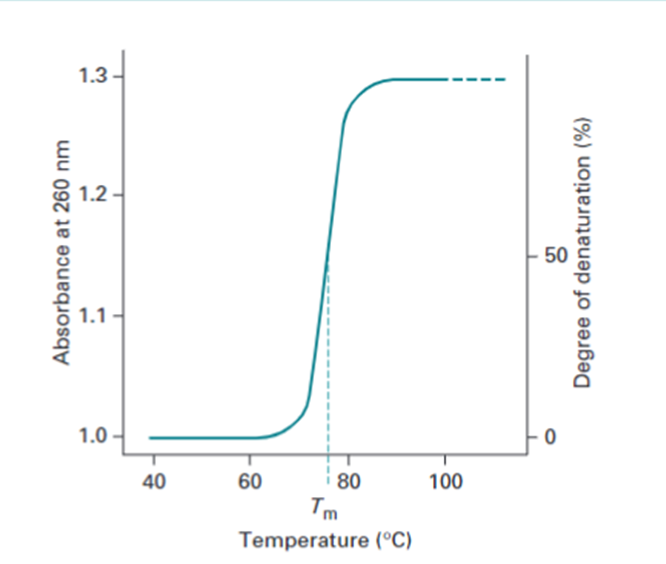
- The loss of helical structure of DNA is known as denaturation. This occurs by the disruption of hydrogen bonds at elevated temperatures.
- The temperature at which half of the DNA molecules are denatured, which is known as melting temperature of DNA.
Measurement of DNA Denaturation
- The double stranded DNA has less absorbance of light at 260nm compared to single stranded DNA, because of the interference by the double helix structure of the DNA.
- As the temperature increases DNA denatures and becomes single stranded, So absorbance increases.
- Alberts B, Johnson A, Lewis J, et al. Molecular Biology of the Cell. 4th edition. New York: Garland Science; 2002. The Structure and Function of DNA. Available from: https://www.ncbi.nlm.nih.gov/books/NBK26821/
What is DNA? (2022, February 18). Yourgenome. https://www.yourgenome.org/facts/what-is-dna
- Freifelder, D. (1990). Molecular biology (2nd ed.). Narosa Publishing House.
- W. (2010). Principles and Techniques of Biochemistry and Molecular Biology (7th ed.). Cambridge India
Thursday, 10 March 2022
PCR - What is it about?
What is PCR?
PCR is the abbreviation of polymerase chain reaction. This term recently got popularity after the COVID-19 pandemic. Also offered job opportunities for many people. That is one amazing fact about PCR!
Well, it is one of the major milestones and a
scientific discovery which redefined the molecular biology. This allows rapid
and cheap amplification of the desired DNA sequence in a sample. This was
developed by Kary Mullis in 1983 and he was awarded Nobel prize this invention
in 1993.
How does it work?
- DNA template to be amplified.
- Primers – 2 types forward and reverse primer. Short
stretches of DNA to start the PCR reaction.
- DNA nucleotide bases (dNTPs) - deoxy
nucleotide triphosphates such dATPs, dCTPs, dGTPs and dCTPs.
A, T, G and C are the building blocks for DNA and are required to synthesize
new strand.
- DNA polymerase enzyme - They duplicate
the DNA strand by adding nucleotides at 3'-OH end. Taq polymerase enzyme extracted
from the bacterium Thermus aquaticus is used as it is
thermostable.
- Buffer – Provide the right conditions for the PCR reaction (also act as a suitable environment for Taq polymerase) such as pH, ions etc.
Steps involved:
- Denaturation – the hydrogen bonds between the two DNA strands get break at temperatures >900C. So, the double stranded DNA converts to single stranded DNA. The denaturation temperature varies for each DNA sequence based on the A-T and G-C pairs.
- Annealing – The temperature cooled down to 40-600C, the bonding between primer and desired DNA sequence occurs in this temperature. The precise temperature is to be optimized for each primer and PCR reaction. The primer has free 3'-OH end where the DNA polymerase can act. That is the next step.
- Extension – This is the DNA synthesizing step. The temperature is raised up to around 720C, which is the optimum temperature for the DNA polymerase enzyme, which add nucleotides at 3' end and the DNA synthesis (new strand) proceeds from 5'end to 3'end.
Thus, after repeating these 3 steps for several times (approximately 30-40 cycles) results in million copies of DNA. The number of double stranded DNA is doubled in each cycle. After the 'n' number of cycles, 2n copies of DNA is produced. E.g.: after 5 cycles, you have 32 copies of DNA!
Three cycles in PCR, 5'-3' denotes primer
Where it all takes place?
Thermocycler (DNA amplifier) is used to amplify the desired DNA sequence. These are the simple devices which provide the precise control of temperature and similar rates of cooling and heating for PCR tubes in different parts of the heating blocks. The tubes with PCR reaction mixture can be placed in the holes of the heating block.
Important points to set up a PCR
- As the PCR technique deals with very minute
amounts of DNA, even small traces of contaminants can severely interfere the
entire process. So, good cleanliness should be maintained while setting up a
PCR.
- Even the aerosols from the pipetting can cause cross contamination, so good pipetting technique is needed.
- Proper labelling of tubes and quality control
procedures are required.
- PCR set up should be done in a separate sterile hood or flow cabinet.
Detection
PCR products are analyzed by agarose gel electrophoresis. The PCR products are identified by ethidium bromide or non-toxic dyes such as SYBR green. The band intensity is used to identify the desired PCR product with respect to the DNA ladder (fragments of DNA of known base pair).
Applications of PCR
|
Area where PCR used |
Application |
|
Molecular Diagnostics |
Genetic testing, detection of oncogenic
mutations, detection of infectious diseases |
|
Forensic Science |
Scenes of crime |
|
Agriculture |
Food pathogen detection, plant genotyping |
|
Sequence analysis |
DNA sequencing |
|
Protein Engineering |
Production of novel proteins |
References
- W. (2010). Principles and Techniques of Biochemistry and Molecular Biology (7th ed.). Cambridge India
- P. Arora, M. (2005). Genetic Engineering (1st ed.). Himalaya Publishing House.
- What is PCR (polymerase chain reaction)? (2021, July 21). Yourgenome. https://www.yourgenome.org/facts/what-is-pcr-polymerase-chain-reaction
Hyperthyroidism
The hormones required for the body’s functions such as growth, reproduction, metabolism, homeostasis, some immunological functions...
-
The XE variant of Covid-19 has started spreading among people and it is a highly transmissible virus!!! Yes guys, it is Covid-19 pandem...
-
What is PCR? PCR is the abbreviation of polymerase chain reaction. This term recently got popularity after the COVID-19 pandemic. Also o...
-
Here, we can have a brief discussion on the fundamentals of DNA isolation. What is DNA isolation? The process of isolating DNA from variable...